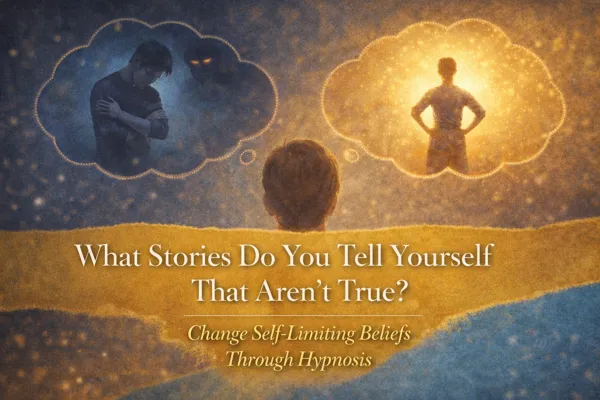
Self-Limiting Beliefs
What Story Are You Telling Yourself That Isn’t True?
Every human mind tells stories.
From the moment we wake up to the moment we fall asleep, there is a quiet narrator in the background of our awareness explaining who we are, what our life means, and what we believe is possible.
Sometimes those stories empower us.
Sometimes they imprison us.
And often, the most limiting stories are the ones we repeat so often that we stop questioning whether they are actually true.
“I’m not good enough.”
“I always fail.”
“People like me don’t succeed.”
“It’s too late for me.”
These statements rarely begin as facts. They begin as interpretations of experiences — and over time they harden into beliefs that quietly shape our identity and our future.
The truth is this: the stories you tell yourself about who you are will either become the architecture of your success or the walls of your self-limitation.
Understanding how these stories form — and how they can be rewritten — is one of the most powerful aspects of personal transformation. Hypnosis is one of the tools that allows us to access and reshape those stories at the level where they were originally created.
The Mind Is a Storytelling Machine
Psychologists often refer to humans as “meaning-making creatures.”
We naturally construct narratives to explain our experiences. These narratives help us organize memory, predict the future, and understand our identity.
However, the brain does not always prioritize accuracy — it prioritizes coherence.
Once the brain forms a belief about who we are, it tends to look for evidence that confirms that belief while ignoring information that contradicts it. This process is known as confirmation bias, and it reinforces the stories we tell ourselves over time. [Rumen]
For example:
A child who receives repeated criticism may unconsciously form the belief:
> “I’m not capable.”
Years later, even when that person achieves success, the mind filters reality through that original story.
Success becomes luck.
Mistakes become proof.
Opportunities feel threatening.
The narrative survives because the brain is trying to maintain consistency with its existing belief structure.
Psychological research shows that these core beliefs often operate beneath conscious awareness, quietly directing behaviour, emotional responses, and decision-making throughout life. [Rumen]
In other words, we are often living out stories we did not intentionally choose.
How Self-Limiting Narratives Shape Our Lives
Self-limiting beliefs are not simply negative thoughts.
They are deeply embedded assumptions about who we are and what we are capable of.
Examples include:
* “I’m not confident.”
* “I’m bad with money.”
* “I always sabotage relationships.”
* “I’ll never be healthy.”
* “People will reject the real me.”
These beliefs influence our behaviour in subtle but powerful ways.
Psychologists have observed that when people carry negative core beliefs, they often unconsciously act in ways that reinforce those beliefs — creating a self-fulfilling cycle. [PositivePsychology.com]
For example:
Someone who believes they are “not confident” may avoid situations where confidence could develop.
Someone who believes they “always fail” may stop trying sooner than someone who expects success.
Someone who believes they are “unworthy of love” may unconsciously choose relationships that reinforce that belief.
Over time, these behaviours create experiences that appear to confirm the original story.
The mind then says:
“See? I told you.”
But what the mind rarely recognizes is that the story itself may have been shaping the outcome all along.
Your Nervous System Learns the Story Too
Self-limiting narratives do not only live in the thinking mind.
They also become embedded in the nervous system.
For example:
A person who believes the world is unsafe may develop chronic hypervigilance.
Someone who believes they must constantly prove their worth may live in a state of perpetual stress and overachievement.
Someone who believes they are powerless may experience learned helplessness or avoidance.
The body begins to react automatically based on the story it has learned about reality.
This is why simply “thinking positive” rarely changes deep patterns.
The story exists not only in language — it exists in emotional memory, unconscious expectation, and physiological response.
To truly change the story, we must access the deeper layers of the mind where those patterns were formed.
This is where hypnosis becomes powerful.
How Hypnosis Helps Rewrite the Story
Hypnosis works by guiding the mind into a focused, receptive state where the critical analytical filters of the conscious mind temporarily soften.
In this state, the subconscious becomes more responsive to new perspectives, imagery, and meaning.
Research in clinical hypnosis shows that hypnotic suggestion can produce measurable changes in perception, emotion, and behaviour, demonstrating the mind’s ability to reorganize internal experience when guided appropriately. [American Psychological Association]
Modern research also shows that hypnosis can significantly influence psychological and physiological outcomes across many conditions, often producing moderate to strong therapeutic effects in clinical studies. [PMC]
When applied to belief transformation, hypnosis can help individuals:
* Access the origins of limiting narratives
* Reinterpret past experiences
* Introduce new empowering beliefs
* Create emotional experiences that support the new story
In essence, hypnosis allows the brain to update the narrative it has been running automatically.
Rewriting the Narrative
One of the most transformative realizations a person can have is this:
Your thoughts are not always facts.
They are interpretations.
And interpretations can change.
The process of rewriting the story often begins with a simple but powerful question:
What story am I telling myself about this situation?
And then an even deeper question:
Is that story actually true?
Often, the answer is surprising.
For example:
“I’m bad with relationships” may really mean
“I learned unhealthy relationship patterns early in life.”
“I’m not confident” may really mean
“I haven’t practiced confidence yet.”
“I always fail” may really mean
“I learned to quit before success had time to develop.”
When these stories are examined consciously — and then reframed through hypnotic imagery, emotional processing, and subconscious suggestion — the brain begins to construct a new narrative.
One that allows for possibility rather than limitation.
The Brain Is Capable of Change
One of the most hopeful discoveries in neuroscience over the past few decades is neuroplasticity.
The brain is not fixed.
It is constantly reorganizing itself based on experience, attention, and repeated thought patterns.
This means that the stories we repeat internally are literally shaping the neural pathways that guide our perception and behaviour.
When new thoughts, emotions, and experiences are introduced repeatedly — especially in relaxed or focused states like hypnosis — the brain begins to form new patterns.
Old stories lose their emotional charge.
New beliefs gain strength.
And gradually, the identity we carry begins to shift.
A Different Question
Instead of asking:
“Why does this always happen to me?”
What if we asked:
“What story about myself might be shaping this experience?”
Instead of assuming the inner narrator is correct, we can begin to examine it with curiosity.
Because sometimes the voice in our mind is not telling the truth.
Sometimes it is repeating something learned long ago from fear, criticism, or misunderstanding.
And sometimes the most powerful moment of transformation begins when we realize:
That story is no longer mine.
The Chrysalis Moment
Transformation rarely happens by force.
It happens through awareness.
In nature, the chrysalis is the stage where the caterpillar dissolves its old structure before emerging as something entirely new.
Human transformation works in a similar way.
Before we can become someone new, we must examine the story we have been living inside.
And ask:
Is this story still true?
If it is not, then we have permission to write a new one.
Through reflection, awareness, and tools like hypnosis that access the deeper mind, it becomes possible to gently release the narratives that once limited us.
And in their place, we can begin telling a different story.
One where growth is possible.
One where healing is allowed.
One where the person you are becoming is no longer constrained by the story you once believed.
So ask yourself today
What story are you telling yourself that might not actually be true?
And if that story changed...Who could you become?
Research Sources
• American Psychological Association (APA)
• Nature Reviews Neuroscience
• International Journal of Clinical and Experimental Hypnosis
• American Psychologist Journal
• Review of General Psychology
