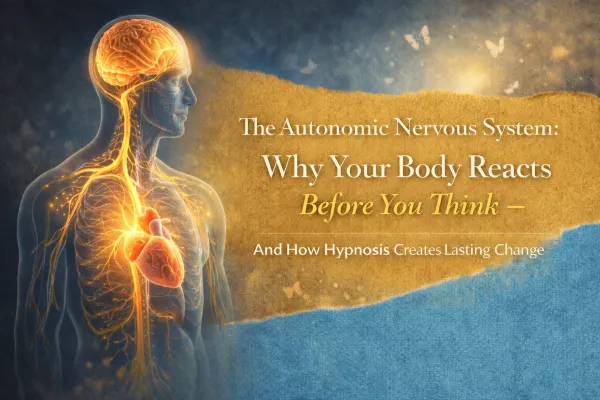
Why Your Body Reacts Before You Think
Most people believe change begins with willpower.
Think better. Try harder. Be more disciplined. Stay positive.
But lasting change does not begin in the conscious mind.
It begins in the autonomic nervous system.
If you have ever:
Known you were safe but still felt anxious
Wanted to relax but couldn’t
Felt chronic pain with no clear structural cause
Reacted emotionally before you could “logic” your way out of it
Then you have experienced your autonomic nervous system in action.
Understanding this system changes everything about how we approach healing, anxiety, pain, confidence, and even self-worth.
What Is the Autonomic Nervous System?
The autonomic nervous system (ANS) is the part of your nervous system that runs automatically.
You do not consciously control it.
It regulates:
Heart rate
Breathing rhythm
Blood pressure
Digestion
Muscle tension
Hormone release
Stress response
Pain perception
It constantly scans your environment and your internal state for one question:
“Am I safe?”
Based on that assessment, it shifts you into one of several states.
The Two Primary Branches
Sympathetic Nervous System
Mobilization. Activation. Fight or flight.
Increased heart rate, shallow breathing, muscle tension, vigilance.Parasympathetic Nervous System
Regulation. Rest. Digest. Repair.
Slower breathing, lowered heart rate, digestion resumes, muscles soften.
Modern trauma science (often discussed through polyvagal theory) further describes nuanced states such as freeze or shutdown, but at its core, the ANS is a dynamic safety system.
It is not trying to sabotage you. It is trying to protect you.
Why Insight Alone Doesn’t Create Change
You can understand your patterns intellectually.
You can read every book. You can journal. You can affirm.
But if your autonomic nervous system remains in survival mode, your body will override your insight.
This is why:
Anxiety persists even when you “know” nothing is wrong.
Chronic stress continues despite positive thinking.
Self-sabotage shows up even when you want success.
Because the ANS does not respond to logic.
It responds to perceived safety or threat.
Lasting change happens when the body experiences safety consistently enough to rewire its default responses.
The Nervous System Learns Through Experience, Not Instruction
Your autonomic nervous system is adaptive.
It learned your current responses through repetition:
Repeated stress
Repeated emotional experiences
Repeated environmental cues
Repeated beliefs paired with emotional charge
If you grew up in unpredictability, your system may default to hypervigilance.
If you experienced emotional invalidation, your system may default to tension or shutdown.
These are not character flaws. They are nervous system adaptations.
The beautiful truth?
If the nervous system learned through experience, it can also relearn through new experiences.
This is where hypnosis becomes powerful.
How Hypnosis Influences the Autonomic Nervous System
Hypnosis is not mind control. It is not loss of awareness.
It is a focused, absorbed state in which:
The body softens
The breath deepens
The critical mind quiets
The nervous system downshifts
When you enter hypnosis, several physiological shifts occur:
Breathing slows and becomes diaphragmatic
Heart rate variability improves
Muscle tension decreases
Cortisol begins to lower
Vagal tone increases
These are markers of parasympathetic activation.
In simple terms:
The body feels safe enough to stop bracing.
And when the body stops bracing, the mind becomes more flexible.
Why Imagery Changes the Body
Your brain does not strongly distinguish between vividly imagined experience and real experience.
When you imagine:
Gentle ocean waves
A safe forest clearing
Warm sunlight spreading through your chest
Your body responds as if safety is present.
Heart rate adjusts. Muscles soften. Breathing synchronizes.
This is not placebo.
It is neurobiology.
When safety is rehearsed repeatedly in a regulated state, the nervous system begins to encode a new baseline.
Over time, your system learns:
“Calm is possible.” “Safety can exist.” “I do not have to mobilize immediately.”
This is how lasting change begins.
Suggestion and Repatterning
During hypnosis, the critical filtering part of the brain relaxes.
This does not mean you lose control. It means you become more receptive to new associations.
If someone is in a regulated state and hears:
“Your body now remembers how to soften more quickly.”
And that suggestion is paired with a felt experience of softness…
The nervous system encodes the pattern.
Not as a belief.
But as a reflex.
This is very different from affirmations.
Affirmations attempt to convince.
Hypnotic suggestion paired with autonomic regulation installs.
Over time, new reflexes replace old ones.
Breathing deepens faster under stress. Shoulders drop sooner. Heart rate stabilizes more quickly. Emotional reactions shorten.
This is nervous system re-patterning.
Post-Hypnotic Anchoring: Bringing Change Into Real Life
Lasting change does not happen in the session alone.
It happens when regulation becomes accessible outside of trance.
In hypnosis, a calm state can be paired with:
A slow breath cue
A hand on the heart
A word like “steady”
A subtle posture shift
When practiced repeatedly, these become autonomic anchors.
Later, when stress arises, the anchor activates the previously encoded parasympathetic state.
This is not forcing calm.
It is recalling safety.
The nervous system begins to learn that mobilization is not the only option.
How This Impacts Anxiety, Pain, and Confidence
Anxiety
Anxiety is often sympathetic dominance.
When the nervous system learns it can downshift reliably, anxiety loses intensity and duration.
You may still feel activation — but you recover faster.
Chronic Pain
Pain perception is influenced by the autonomic state.
Chronic sympathetic activation increases muscle guarding and pain sensitivity.
Regulation reduces tension and often decreases pain amplification.
Confidence
Confidence is not a thought.
It is a regulated nervous system that is not bracing for threat.
When your body feels safe, you speak more steadily. You make decisions more clearly. You tolerate uncertainty with more capacity.
Confidence emerges as a byproduct of regulation.
Why This Creates Lasting Change
Lasting change happens when:
The nervous system repeatedly experiences safety.
New responses are paired with regulated states.
Anchors make those states accessible in daily life.
The new pattern becomes more familiar than the old one.
We do not erase old patterns.
We outgrow them.
Over time, your baseline shifts.
Instead of:
Chronic tension
Hypervigilance
Emotional reactivity
Shutdown
You experience:
Faster recovery
Increased flexibility
Emotional steadiness
Greater resilience
Change becomes embodied, not forced.
Healing Is Not About Forcing Calm
The autonomic nervous system is not broken.
It is protective.
When we approach it with gentleness, not aggression, it responds.
Hypnosis offers:
A structured experience of safety
A pathway to parasympathetic activation
A method for encoding new reflexes
A way to restore trust in the body
You are not reprogramming yourself.
You are teaching your nervous system that safety exists now.
And when the body believes it is safe, everything changes.
Your thoughts shift. Your reactions soften. Your capacity expands.
Lasting change begins not with discipline — but with regulation.
And regulation begins in the autonomic nervous system.
